
India's equity markets are on a roller-coaster ride, after delivering spectacular returns for two consecutive years - in 2020 and 2021. The benchmark National Stock Exchange's (NSE's) Nifty50 is down 1.5 per cent in the first nine months of the current calendar year 2022 (CY22) as foreign portfolio investors sold Indian stocks due to rising bond yields in the US and across global markets, including India. The sell-off in the Indian equity markets has, however, not been broad-based and largely limited to sectors facing earnings headwinds from rising interest rates, lower commodity and energy prices, and likely economic recession in advanced economies.

sharper-than-expected economic recovery back home, analysts say, can fuel a further rally in domestic cyclicals, industrials, and financials as global central banks continue with their easy money policy.

'Higher than expected inflation in the US or the European Union, faster than expected tightening by the major central banks, break out of a war in Europe, and withdrawal of portfolio equities from the emerging markets are factors which can result in equity market corrections.'

Shares of small-cap companies have been on a roll with the S&P BSE Small-Cap index hitting a new high in intra-day deals on Thursday. The rally has been fueled by an up move in stocks of chemicals, cement, graphite electrode makers, pharmaceuticals and information technology (IT) shares. In the past two weeks, since March 25, the index has outperformed the market by gaining 7.3 per cent. In comparison, the S&P BSE Midcap index was up 6.1 per cent, while the S&P BSE Sensex gained 3.6 per cent during the same period.

Of these 26, Bajaj Finance, Associated Alcohols and Breweries, Garware Technologies, Filatex India, Tasty Bite Eatables, Aarti Industries and GMM Pfaudler saw an over 10-fold surge in price since 2014.


'The probability of this being a suckers' rally, where all kinds of beaten down stocks have begun to rally sharply, should be a time to be cautious and circumspect.'

Even when large businesses said they were flying blind in mid-2020, the markets rallied and an incredible business boom followed. This is not to say that the markets will continue to rally and there is nothing to worry about, observes Debashis Basu.

Investor wealth has jumped by over Rs 12.31 lakh crore in three days, taking the market capitalisation of all BSE-listed companies to a record Rs 198.43 lakh crore on Wednesday as equities continued their Budget-driven rally. The BSE benchmark Sensex closed above the historic 50,000 mark for the first time ever on Wednesday. The 30-share benchmark closed with a gain of 458.03 points or 0.92 per cent at 50,255.75. During the day, it zoomed 728.67 points to its lifetime high of 50,526.39. In three trading days, the benchmark has gained 3,969.98 points or 8.57 per cent.

Indian companies' market capitalization has grown at the fastest pace last year among major economies despite contraction in GDP, economists from SBI said, flagging the risks to financial stability it poses. Further, retail investors have shown higher interest in markets and their numbers have increased by 1.42 crore in FY21 and another 44 lakh in April and May, they said in a note, wondering if this will be a lasting behavioural change or is transitory. The economists at the country's largest lender attributed the growth in equity markets to lower returns on other financial instruments amid a low rates regime, increase in global liquidity, and even a tendency to spend more time at home because of mobility restrictions which led many to trade more.
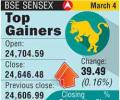
The S&P BSE Sensex ended up by 39 points at 24,646.

Polarisation and the increase in index weight of a few a stocks have weighed on performance. The worst performers include Nippon India Large Cap and HDFC Top 100 (2.6 per cent).

'It will be best for investors to have a systematic investment plan in mid-cap and small-cap funds with a three-/five-year horizon.'
Broader market outperformed the frontline indices with the Smallcap and Midcap gaining up to 1%

After outperforming the broader market and their public sector peers for the better part of the post-Lehman period, private sector banks - such as HDFC Bank, ICICI Bank, Axis Bank, and Kotak Mahindra Bank - are now underperforming. Last week, the Nifty Private Bank index was up just 6 per cent year-to-date in the calendar year 2021, against nearly 13 per cent rally in the Bank Nifty and a 15 per cent rise in the benchmark Nifty50. Public sector (PSU) banks, such as State bank of India, Bank of Baroda, and Punjab National Bank, are now rally leaders and outperforming the broader market. The Nifty PSU Bank index was up 42 per cent since the beginning of this calendar year. But on a longer term, the Nifty Private Bank index is up 101 per cent since March 2016, against a 118 per cent rally in the Bank Nifty and just 2 per cent rise in the Nifty PSU Bank index in the period.
BSE Midcap and BSE Smallcap indices hit their fresh lifetime highs for the second day in a row

The Karnataka election is being seen as the semi-final to the 2019 general elections and appears to be heading towards a close fight
Nifty saw the biggest weekly gain since the first week of September and comfortably maintained its crucial 8250 levels in today's session

Will 2022 be a year of contrasting narratives -- one filled with caution and the other with continued optimism?

The market breadth, indicating the overall health of the market, was positive

After a stellar run that saw the frontline indices - the S&P BSE Sensex and the Nifty 50 - clock gains of around 21 per cent and 24 per cent respectively in calendar year 2021 (CY21), the year gone by in real sense belonged to the mid-and small-cap segments. Thus far in CY21, the mid-and small-cap indexes on the BSE have far outpaced the run in the frontline indices and notched up a gain of around 38 per cent and 61 per cent, respectively during this period. Though analysts expect the outperformance to continue in 2022, they caution against the multiple headwinds in the year ahead that may dent the overall market sentiment.

The latest circular from BSE that sought to cap the price movement of select scrips, especially the mid-, small-cap segments, traded on the exchange is not without a reason. A quick calendar year-to-date price check on the stocks from the categories put under 'Add-on Price Band Framework' by the BSE reveals a total of 210 stocks have seen their market price more than double. Among individual stocks, SC Agrotech, Adinath Textiles, Waaree Renewable Technologies, Steel Strips Infrastructure, Unistar Multimedia, Texel Industries, Raja Bahadur International and Hindustan Everest Tools from the BSE's X and XT group have rallied over 500 per cent during this period. Topping the charts is Gita Renewable Energy, which has zoomed 3,964 per cent to Rs 272.35 now from Rs 6.7 as on December 31, 2020.

Investor wealth zoomed over Rs 10.48 lakh crore in two days as the Budget-driven market euphoria continued to charge bulls on Tuesday.

Global funds have pumped in over Rs 38,000 crore (about $5.5 billion) into domestic equities since February 20, helping the Sensex rebound 2,671 points, or 7.6 per cent, from its 2019 low.

This is first time in 25 years that a benchmark equity index in India is trading at a P/E multiple of 40x or higher.

Government-owned companies are more generous in rewarding their shareholders with dividends.

S&P BSE Sensex settled at 31,170, up 60 points, while the broader Nifty50 closed at record high for third straight session. It ended at 9,624, up 19 points.

The country's top FMCG stocks, such as Hindustan Unilever, ITC, Nestl, Britannia, Godrej Consumer Products, and Dabur, among others, are currently trading at around 41x their trailing 12-month earnings, down from their peak P/E multiple of around 48x at the end of December 2018.

'This market is very expensive in some pockets, dirt cheap in some, and the belly of the market is reasonably valued.'

Liquidity pushed benchmark indices 22% higher to become the best performing equity market globally

Rebound in IT majors TCS and Infosys in late trades helped markets end higher.

While the amount collected is a tad lower than last two years, it may surpass the previous two years' collections by the end of the year.
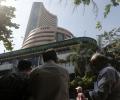
The S&P BSE Sensex ended the day at 28,226, up 85 points, while the Nifty50 settled at 8,734, up 18 points.

No stock on BSE Sensex ended in red while only 3 stocks in the broader Nifty50 index settled the day negative

Even if the bull run may continue, most experts say some profit booking is called for, points out Sanjay Kumar Singh.

The Sensex closed the day at 28,141, up 486 points, while Nifty50 settled at 8,716, up 155 points.

Though most analysts expect the global central banks to keep the liquidity tap open, valuations of Indian markets, they say, are beginning to look stretched. Against this backdrop, they remain cautious, with some even expecting a minor correction from here on.
Portfolio returns, say analysts at Morgan Stanley, are more likely to be driven by bottom-up stock-picking rather than top-down macro forces.

Nifty is likely to remain under selling pressure unless and until it breach the 7,700-7,720 levels on closing basis.

The mid- and small-cap indices had a dream run between January 2017 and January 2018 - zooming 48 per cent and 56 per cent, respectively.
